How long does a 1000-piece puzzle take?
If you've ever wondered how long it will take to finish that puzzle you just opened, you're not alone. The answer for a 1000-piece puzzle is about 5 hours. Putting together puzzles is a fascinating hobby, and thanks to data from our community, we now have clear answers.
The median time for 1000 and 500 pieces
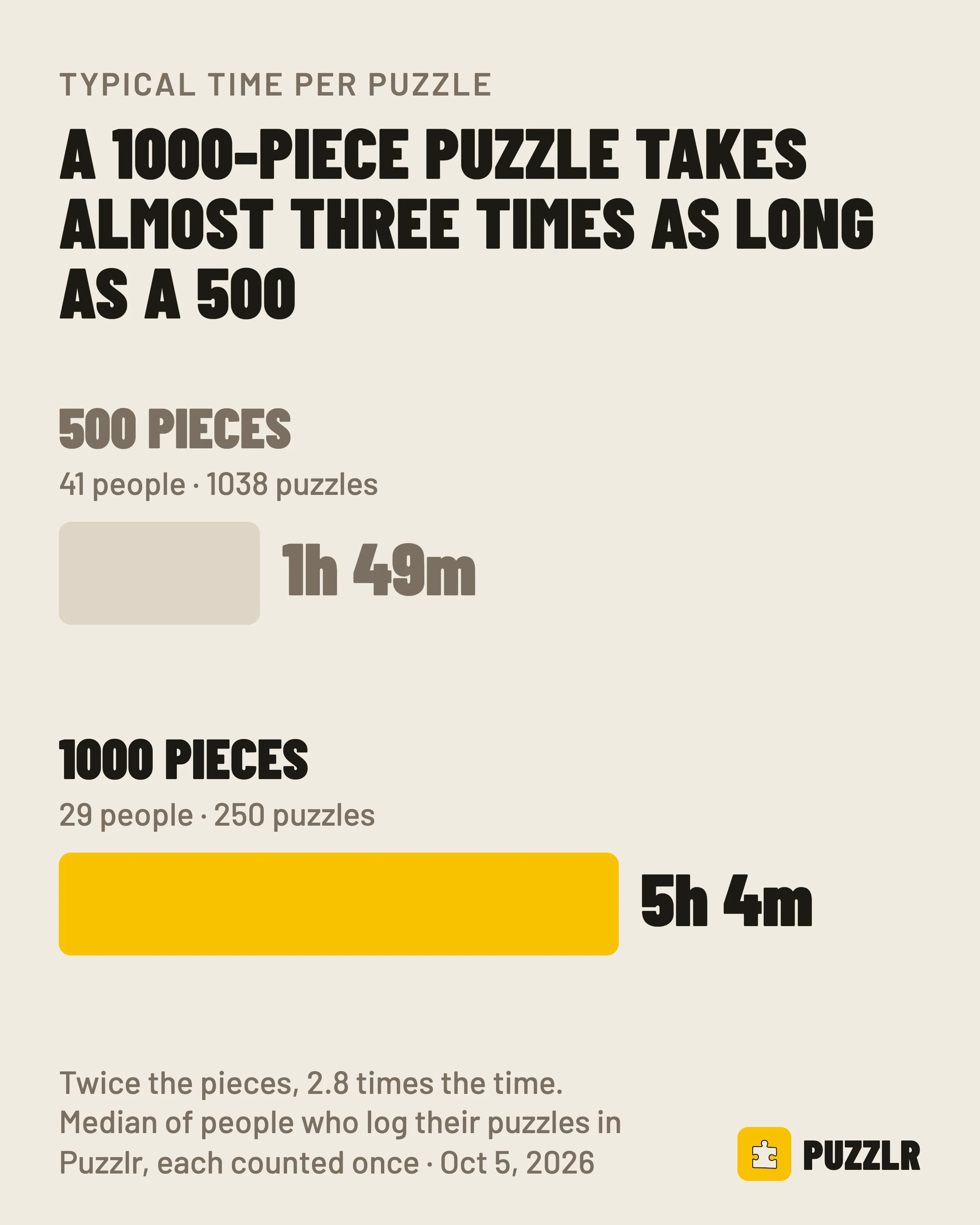
Based on completed puzzles timed by Puzzlr app users at home, the median time to put together a 1000-piece puzzle is 5 hours and 9 minutes. If you prefer a smaller format, the median for 500-piece puzzles is 1 hour and 49 minutes. However, don't get frustrated if it takes you longer: the data shows that one in four people takes over 7.8 hours to complete a 1000-piece puzzle.
| Puzzle size | Median time | Half of the people take between | Base data |
|---|---|---|---|
| 500 pieces | 1 h 49 min | 1.6 and 2.4 h | 1038 completed puzzles by 41 people |
| 1000 pieces | 5 h 4 min | 4.4 and 7.8 h | 250 completed puzzles by 29 people |
Why doesn't a 1000-piece puzzle take twice as long as a 500-piece one?
Logic would tell us it should take twice as long, but the reason is simple: in a 1000-piece puzzle, each piece has twice as many loose pieces to search through. Also, there are twice as many places to try it. Both difficulties increase at the same time. Puzzlr data reveals that going from 500 to 1000 pieces multiplies the time by 2.8. Furthermore, data from the MySpeedPuzzling community shows that this jump almost triples the time (3.0 times). YouTuber Janette, from the channel Janette & Her Puzzles, points out that going from 500 to 1000 pieces was harder for her than going from 1000 to 2000 later.
Where does the time go when putting a puzzle together?
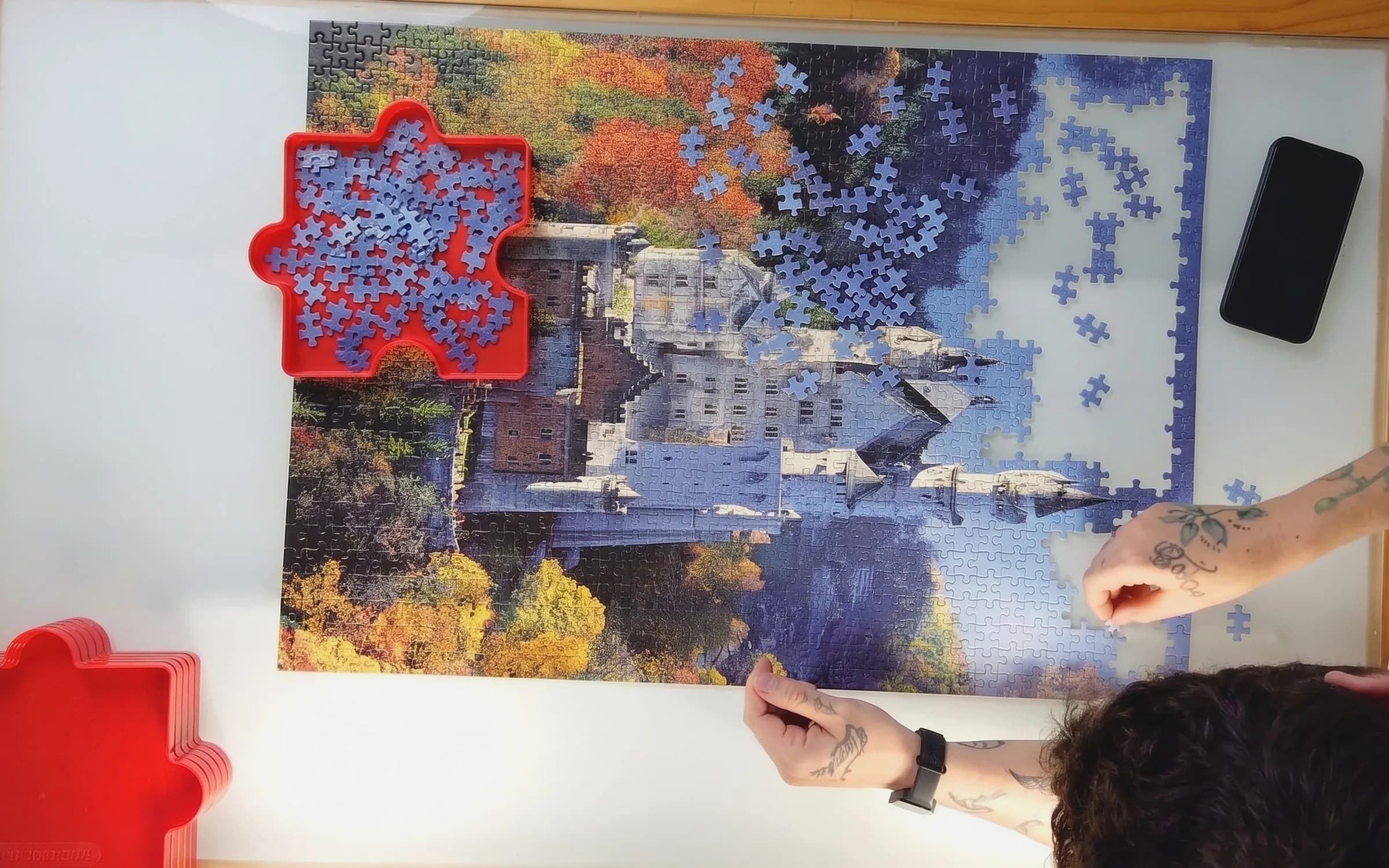
- The process of flipping all the pieces and sorting out the edges takes about half an hour for a 1000-piece puzzle, according to creator Karen Kavett.
- Large single-color areas (like the sky) take a lot of time because they force you to search solely by piece shape.
- Karen Kavett mentions that putting together half of the blue sky pieces took her longer than the rest of the puzzle combined.
- As Marisol from the Paraíso de Rompecabezas channel says: “the sky is hell for puzzle lovers”.
What makes a puzzle take longer?
Besides solid color zones, there are other key factors:
- Cut type: The “ribbon” style cut (even rows) makes almost all pieces have two knobs and two holes, making them easily confused with one another. On the contrary, in a random cut, each piece has its own unique shape.
- Strategy: Starting with what stands out the most helps you progress quickly, because each finished area removes pieces from the table and leaves fewer options to search through.
- The border: Putting together a single-color border is harder.
- Physical size: 1000-piece puzzles aren't all the same size; a Reverie brand model measures 50 × 70 cm, while a Mini A3 format from Ingenio Destreza Mental measures 42 × 29.7 cm.
Hobby at home vs. Competition (Speed Puzzling)
As a hobby (Puzzlr), the median is 5 h 4 min for a 1000-piece puzzle and 1 h 49 min for a 500-piece one. Those who compete or speed train (MySpeedPuzzling) have a median of 3 h 15 min for 1000 pieces and 1 h 4 min for 500 (data from 18,458 completed puzzles by 2,417 people, as of July 11, 2026). At the championship level, the human limit is astonishing: in the 2025 World Jigsaw Puzzle Championship, the winning Polish pair formed by Weronika Huptas and Anna Kazana put together a 1000-piece puzzle in just 54 minutes and 45 seconds. On Puzzlr, there is not enough data from casual pairs to provide an at-home median.
Which day is the most popular for puzzling?
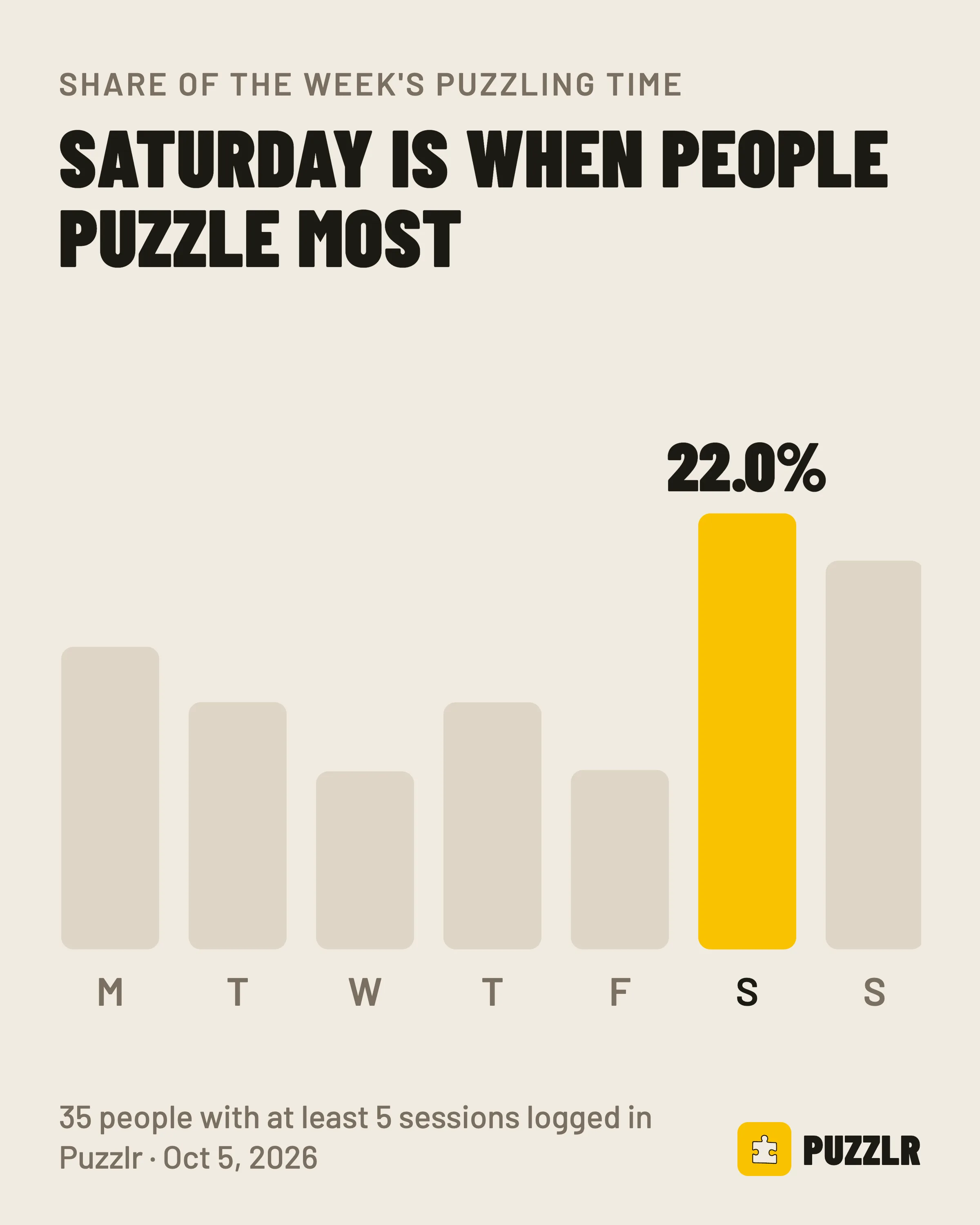
The weekend is the favorite time for this hobby, concentrating 42% of the week's puzzle-solving time. Saturday is the undisputed leader with 22.0% of the time. Sunday follows as the second most popular day with 19.6%. These figures come from 35 people with at least 5 logged sessions:
| Day of the week | Percentage of time |
|---|---|
| Monday | 15.3% |
| Tuesday | 12.5% |
| Wednesday | 9.0% |
| Thursday | 12.5% |
| Friday | 9.1% |
| Saturday | 22.0% |
| Sunday | 19.6% |
How do I calculate how long it will take me?
Alejandro Darias, from the Spanish Puzzle Association, recommends a practical method: count how many pieces you manage to put together in an hour and divide the total number of puzzle pieces by that number. He also warns that it's not a good idea to start with a time goal from the beginning because you'll always fall short. If you lose track of time, don't worry, it's normal; Karen Kavett mentions that she spent nine straight hours puzzling and felt like it was only two.
Measure and track your time with Puzzlr
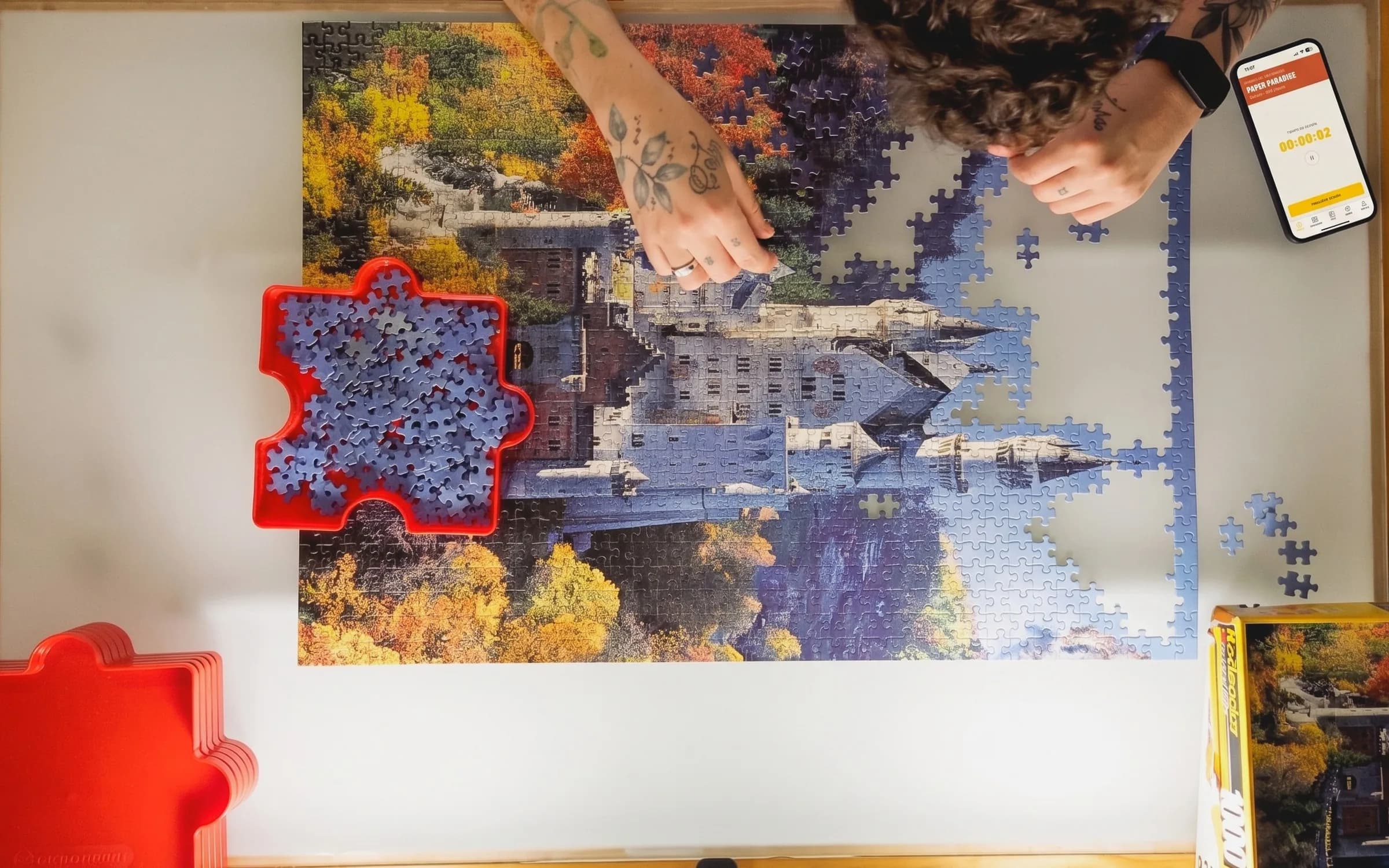
The best way to know your own pace is to track it:
- Download the free Puzzlr app on the App Store or Google Play.
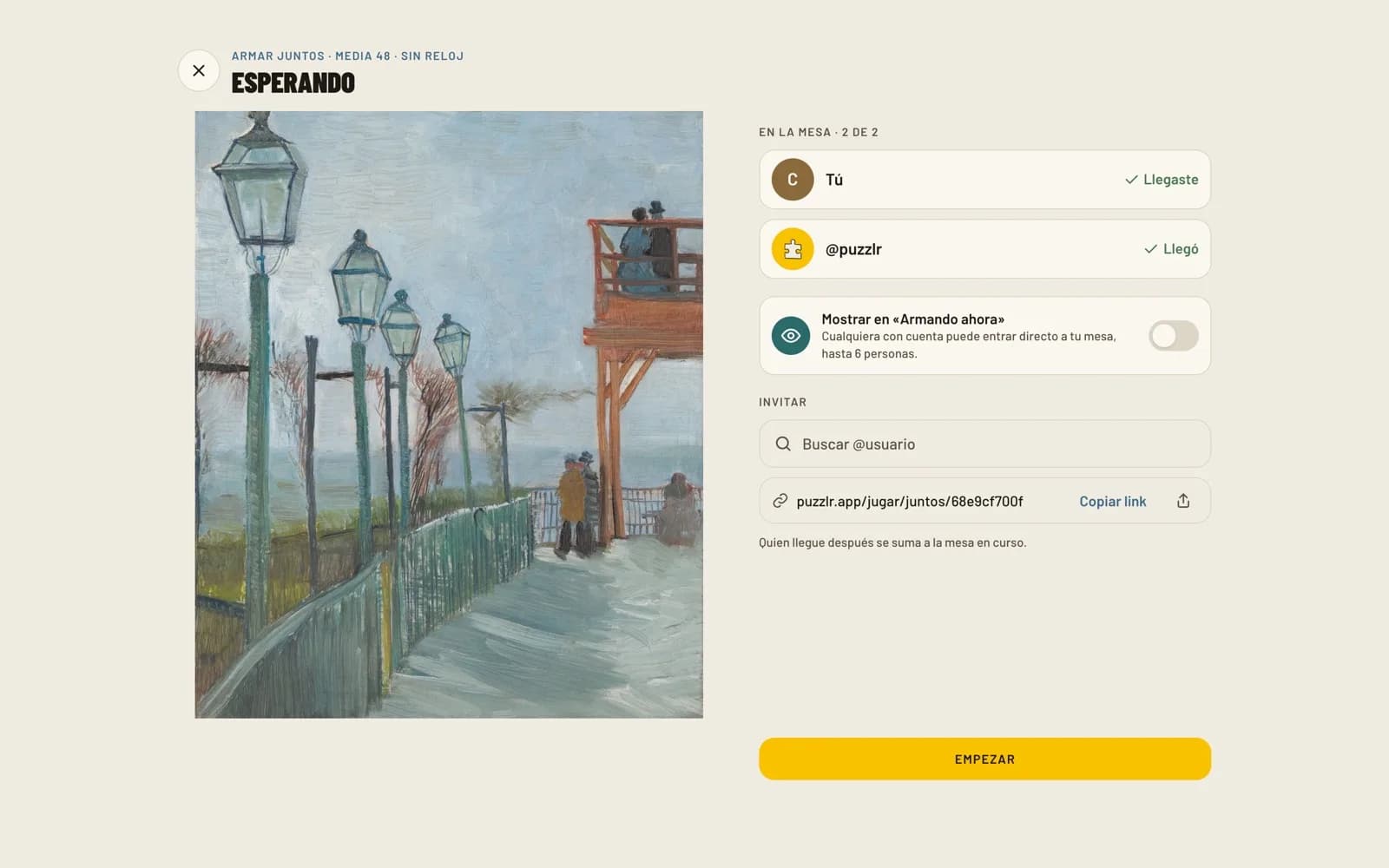
- With the app, you scan the box, start a session with the timer, and you pause it when you get up from the table.
- You can also log past sessions with an approximate time.
- When finished, you will see your total time and how many sessions it took you to complete it.
Inside each puzzle's details, the app lets you compare your personal time with the community median and record. If you're looking for a shorter challenge before tackling a big box, check out our Daily Jigsaw Puzzle on the Puzzlr website. We offer a new artwork every day that can be put together in the browser in a few minutes, for free and without installing anything. And if you need more help for your next project, check out our complete guide on how to do a 1000-piece puzzle on puzzlr.app.
Where do these numbers come from
To calculate these figures, we first get each person's median time and then the median of all of them (so each person counts as one). Accounts of the Puzzlr team are left out, as well as completed puzzles under 30 minutes or where the user forgot to pause the timer. Data is only published when there are 20 or more people, which is why there are no figures yet for 300, 1500, and 2000-piece puzzles.
Frequently asked questions
-
How many hours does it take to put together a 1000-piece puzzle?
The median time as a hobby is 5 hours and 9 minutes, though one in four people takes more than 7.8 hours. -
How long does it take to put together a 500-piece one?
The median is 1 hour and 49 minutes. It takes less than half the time because there are fewer loose pieces to search for and fewer places to try them. -
Is it normal to take more than 8 hours on a 1000-piece one?
Yes, it's completely normal. Our data shows that at least 25% of users take more than 7.8 hours. -
How long does it take for two people?
Although we don't have enough data on Puzzlr to give an exact at-home median, as a championship reference, the winning pair of the 2025 World Jigsaw Puzzle Championship put it together in under 55 minutes. -
How many days does it take to finish a 1000-piece puzzle?
It depends on your pace, but if you work on it for an hour a day, it will take you about five days. If you dedicate a full weekend to it, you could complete it in a couple of days. -
How long does it take to sort the pieces?
The initial process of flipping all the pieces and sorting out the edges takes about 30 minutes for a 1000-piece puzzle.